
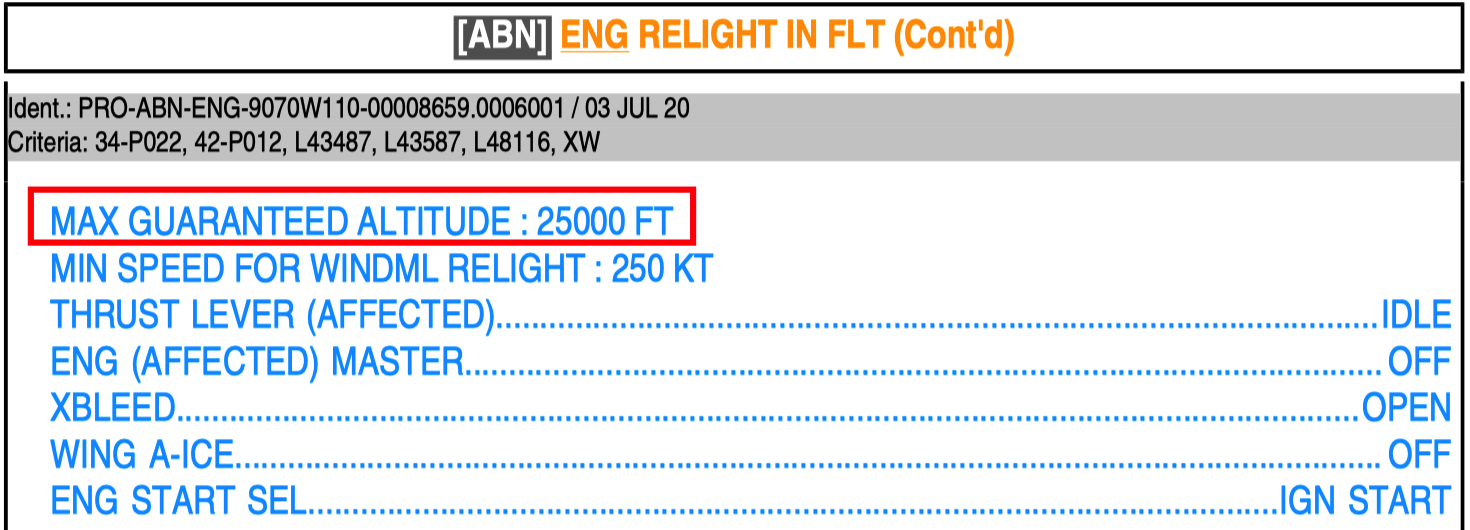
在 [ABN] ENG RELIGHT IN FLT 程序中提到最大有保证的高度是 25000ft:
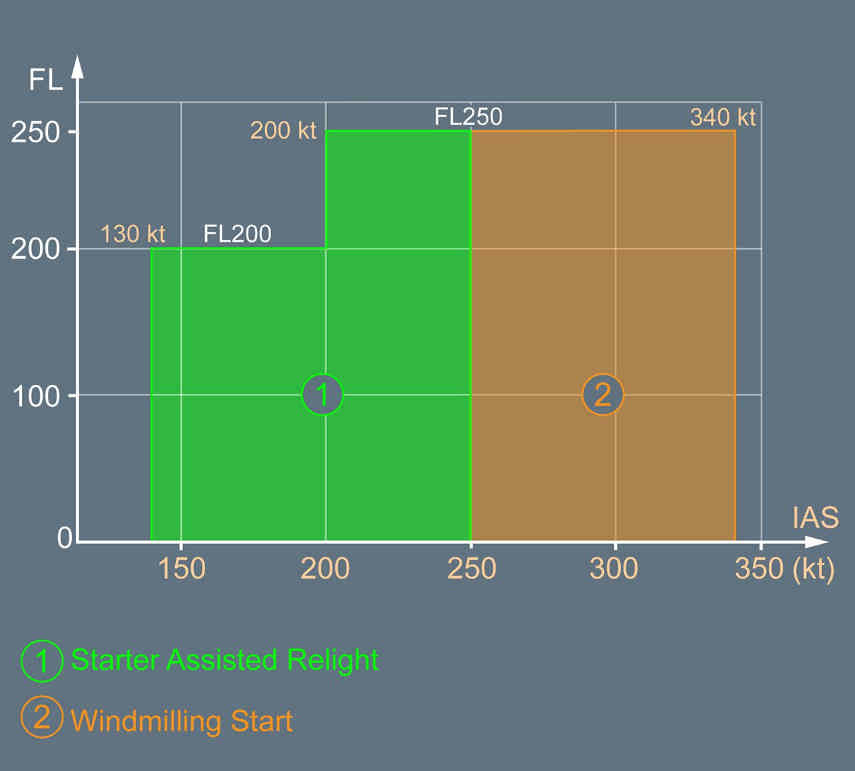
同时提供了重启包线:
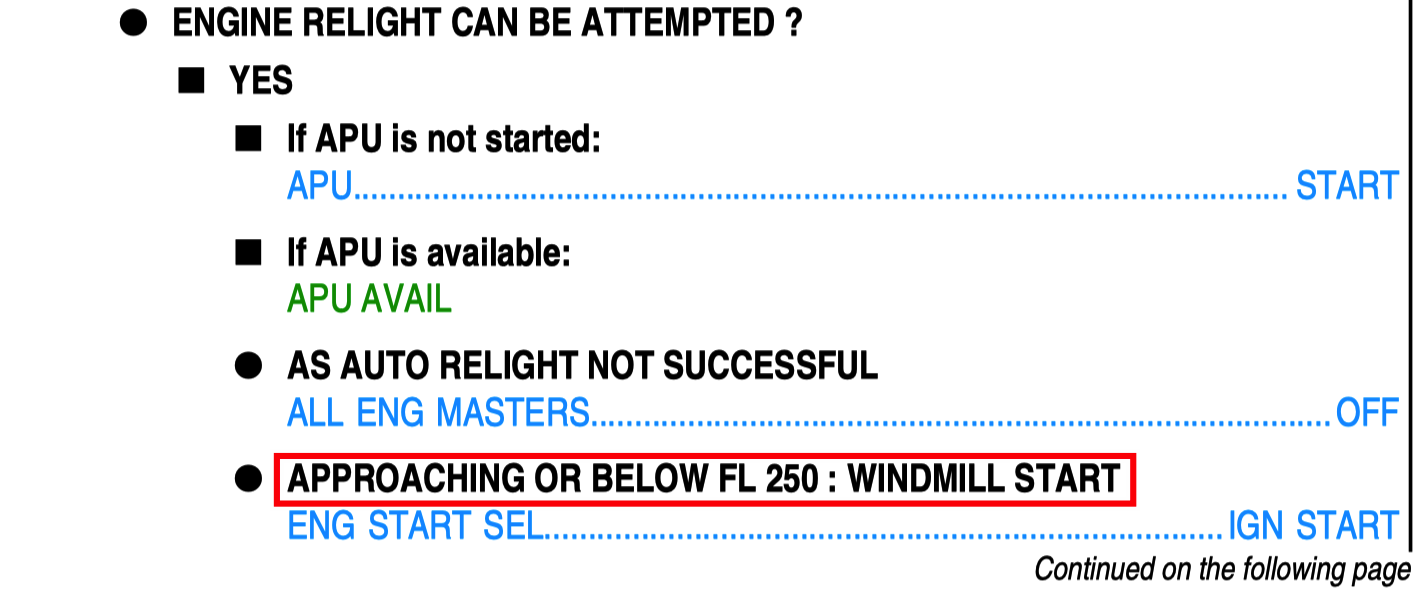
在 ENG ALL ENGINES FAILURE 程序中也要求接近 FL250 再进行风转启动:
有三个问题。
问题 1:如果双发失效,从高高度下降到 FL250 之间就不能尝试重启发动机,只能飘降么?为什么?
问题 2:“APPROACHING OR BELOW”中的 APPROACHING 是指多高?
问题 3:FL250 以下都可以用 APU 引气辅助启动了,为什么还要用风转?如果有必要用,那用几次再切换 APU 辅助启动?
空客解释说,程序中提到的最大保证高度,对应的是在该高度以下,重新点火成功率经验证能够满足法规要求。FL250 以上,随着气压和温度下降,重新起动发动机所需的条件变得更加严苛,并会影响重新点火能力。
对于单发失效来说,在 ENG RELIGHT IN FLT 程序中,实际上并没有限制机组在 FL250 以上尝试发动机重新点火,前提是该操作不会干扰机组对故障恢复策略的执行。然而,在 FL250 以上尝试发动机重新点火,并不保证发动机会重新起动。因此,程序建议确保遵守最大高度限制,以给发动机最大重新点火机会。
而对于双发失效,FADEC 首先会尝试自动重新点火发动机。如果自动重新点火失败,FADEC 将继续尝试重新点火,直到该过程被中断。之后,如果 FADEC 指示自动重新点火序列失败,或者机组将主电门置于 OFF 位,ECAM 上将显示 AS AUTO RELIGHT NOT SUCCESSFUL 程序。
对此,我的理解是,FL250 以上如果 FADEC 自动重启都不成功,人工再去尝试大概率也不行。所以不如先干点别的,比如找备降场、联系 ATC 和 AOC、与客舱做好沟通等等。反正这些事儿总得做,不如在发动机启动概率低的时候做,优化工作负荷。
至于“APPROACHING OR BELOW”中的 APPROACHING 是指多高?空客认为机组可以考虑在 FL270 至 FL260 之间,将发动机主电门循环至 OFF 30 秒,以便对发动机燃烧室进行通风。然后,在 FL250,机组将两个主电门置于 ON,并必须监控 N3、FF 和 EGT 参数,以检查重新点火是否成功。
关于风转启动和 APU 引气辅助启动,应优先选择风转重新点火,因为可以两台发动机同时起动。Airbus 建议尝试不止一次风转起动,但是,到底尝试几次空客一如既往的没有说明,只是说“这应基于机组判断以及飞机相对于地形或机场的高度”。
TR-81744468 原文
Q1
Q1
In the procedure [ABN] ENG RELIGHT IN FLT, it states:
MAX GUARANTEED ALTITUDE: 25000 FT
The procedure of ENG ALL ENGINES FAILURE also specifies:
APPROACHING OR BELOW FL 250: WINDMILL START
Is this because the air density at high altitude is too low to achieve the required rotational speed for engine start?
Q2
In the event of ENG ALL ENGINES FAILURE, the engine will attempt an automatic restart.
If the automatic restart fails due to insufficient air density at high altitude, what is the success probability?
Is the restart attempted using the remaining high rotational speed during the short period after failure?
And does this follow the same logic as the WINDMILLING QUICK RELIGHT FUNCTION described in DSC-70-10-80-20 D?
Q3
The ENG ALL ENGINES FAILURE procedure mentions:
APPROACHING OR BELOW FL 250: WINDMILL START
What altitude range above FL 250 does the term APPROACHING cover?
A1
A1)
Please be informed that the capability to relight the engine (as instructed in the ENG RELIGHT IN FLT procedure), was demonstrated during the A350’s certification.
The maximum guaranteed altitude mentioned in the procedure corresponds to the altitude under which the rate of successful relight is acceptable in regards to the regulation requirements.
Above this value (FL250), as the air pressure and temperature decrease, the effort required to restart the engine increases and affects the relight capability.
In the ENG RELIGHT IN FLT procedure, there is actually no restriction to attempt engine relight above FL250 (maximum guaranteed altitude) provided that it does not disturb the flight crew from the failure recovery strategy. However, attempting an engine relight above FL250 does not guarantee the engine will restart. It is then recommended by the procedure to ensure maximum altitude is respected in order to give the engine maximum chance to relight.
A2)
In case of ALL ENGINES FAILURE, first FADEC will try to autorelight the engine.
If autorelight fails, the FADEC will continue to attempt to relight the engine until interrupted, then the procedure AS AUTO RELIGHT NOT SUCCESSFUL will be displayed on the ECAM if the FADEC indicates the autorelight sequence has failed or if the flight crew has set the master lever to OFF.
Please be informed that the quick relight is effective if the rotary selector is on NORM position and the master lever is cycled from On to Off to ON again.
If the rotary selector is on IGN/START position, and the master lever is cycled from On to Off to ON again, an automatic start is commanded instead of a quick relight.
A3)
In case of ALL ENGINES FAILURE, first FADEC will try to Autorelight the engine. If the Autorelight is not successful and if engine relight can be attempted, a windmilling start can be attempted (at adequate altitude for windmilling), refer to APPROACHING OR BELOW FL 250 : WINDMILL START in the FCOM.
Therefore, we confirm that the flight crew can attempt a windmilling start at FL250 (certified altitude for windmilling start) or below FL 250. The term APPROACHING should be understood as “at approaching FL 250”.
Q2
Thank you for the explanation. However, the term APPROACHING OR BELOW FL 250 is still not specific enough. What I would like to know is the range or order of magnitude of “approaching” — does it refer to a few hundred feet, 1000 ft, 3000 ft, or 5000 ft, etc.? In other words, what is the highest altitude you would consider as APPROACHING FL 250?
Additionally, you mentioned:
In the ENG RELIGHT IN FLT procedure, there is actually no restriction to attempt engine relight above FL250 (maximum guaranteed altitude) provided that it does not disturb the flight crew from the failure recovery strategy.
Does this also apply to ALL ENGINES FAILURE? That is, after an automatic relight is unsuccessful (indicated as AS AUTO RELIGHT NOT SUCCESSFUL), the flight crew may still attempt engine relight even if not yet at FL 250, and this will not have any impact on the relight attempts after APPROACHING OR BELOW FL 250.
A2
A1) Refer to our answer in message /003, a windmilling start can be attempted (at adequate altitude for windmilling), that being said, in case of ALL ENGINES FAILURE, the flight crew can attempt a windmilling start at FL250 (certified altitude for windmilling start) or below FL 250.
However, in the ECAM line APPROACHING OR BELOW FL250: WINDMILL START, the flight crew can start with these first few actions before FL250:
- ENG START SEL……IGN START and
- ALL ENG MASTERS OFF 30S then, the action to turn ON the ALL ENG MASTER needs to be below FL250 to ensure a successful start.
As mentioned in the ALL ENGINE FAILURE procedure, the flight crew is required to adapt the speed to 250 kt which is the minimum speed for optimal relight on A350. Given a glide ratio of 2.5NM/1000FT, the flight crew may consider cycling the engine master levers to OFF for 30 seconds between FL270 and FL260 to ventilate the combustion chamber of the engines.
During this 30-second period, expect an altitude loss of at least 2,000 ft. Then, at FL250, the flight crew sets both master levers to ON, they must monitor the N3, the FF and the EGT parameters, to check if the relight is successful.
A2) No, as per A1, the flight crew can attempt a windmilling start at FL250 (certified altitude for windmilling start) or below FL 250 in case of ALL ENGINES FAILURE.
Q3
Thank you for your explanation regarding “APPROACHING OR BELOW FL 250”. However, this raises another question.
According to the procedure, if an automatic restart is unsuccessful, a windmill start may be attempted when APPROACHING (between FL 270 and FL 260) OR BELOW FL 250, with repeated restart attempts until successful or until APU bleed is available.
But APU bleed air becomes available below FL 250. Descending from FL 270 to FL 250 takes roughly only one minute, and all engine masters must be turned off for 30 seconds first.
Does this mean that only one windmill start attempt at most can be made before switching to an APU‑assisted start? If so, is the value of this windmill start rather limited, making it better to perform an APU‑assisted start directly at FL 250?
A3
As mentioned in the FCOM ENG ALL ENGINES FAILURE procedure, Airbus recommends performing windmill relight.
Below FL 250, if the crew decides that engine relight can be attempted, priority should be given to windmill relight. This windmill start sequence allows trying both engine starts simultaneously.
Airbus recommends attempting more than one windmill start if APU bleed is still unavailable. The crew should do this windmill start sequence regularly and as long as it is possible. This should be based on flight crew judgment and aircraft altitude above terrain/airport.
If windmill start is unsuccessful, the crew should decide to reduce speed down to green dot in order to save aircraft altitude.
When flying at green dot, the crew still has the possibility to try to relight one engine at a time using APU bleed (Starter Assisted Relight).
We recommend CSC refer to the FCTM All Engines Failure – ECAM procedure section for Airbus guidance on managing the all engines failure situation.
Q4
I agree that one advantage of windmill start is that both engines can be started simultaneously.
If we attempt the first windmill start at FL270 and it is unsuccessful, and by the time we reach FL250 APU bleed becomes available, does Airbus recommend continuing with windmill start or switching to APU-assisted start?
If windmill start is still recommended, how many attempts should be made before switching to APU-assisted start?
A4
We remind CSC again that the flight crew can attempt a windmilling start at FL250 (certified altitude for windmilling start). We confirm that, at or below FL250, if the flight crew decides that engine relight can be attempted, it should give priority to windmill relight. This windmill start sequence allows both engines to start simultaneously. Airbus recommends attempting more than one windmill start.
Then, referring to the Engine Relight Envelope, the FADEC selects a start assisted relight when N3 is below 6 % or the airspeed is below 250 kt.
