
参考 PRO-NOR-SOP-180-A B CROSS-REFERENCE TABLE,RNAV(GNSS) 有两种可用的引导方式:
- 对于 LNAV/VNAV minima 的 RNAV(GNSS) 进近,只能使用 XLS 引导
- 对于 LNAV minima 的 RNAV(GNSS) 进近,可以使用 XLS 引导,或者 NAV FPA 引导。
对于 LNAV minima 的 RNAV(GNSS) 进近,如果使用 XLS 引导,依据 PRO-NOR-SOP-180-C A 的要求,需要参考 PRO-SPO-PBN J RNP APCH/RNAV(GNSS) – REQUIRED RNP APCH EQUIPMENT 来确认所需设备。可以看到,是明确需要 FD 的。
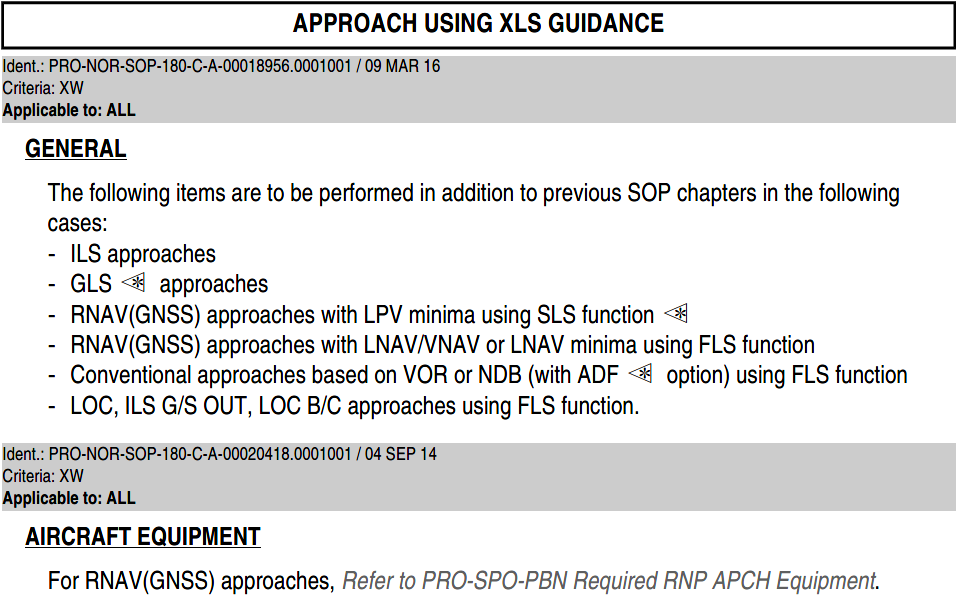
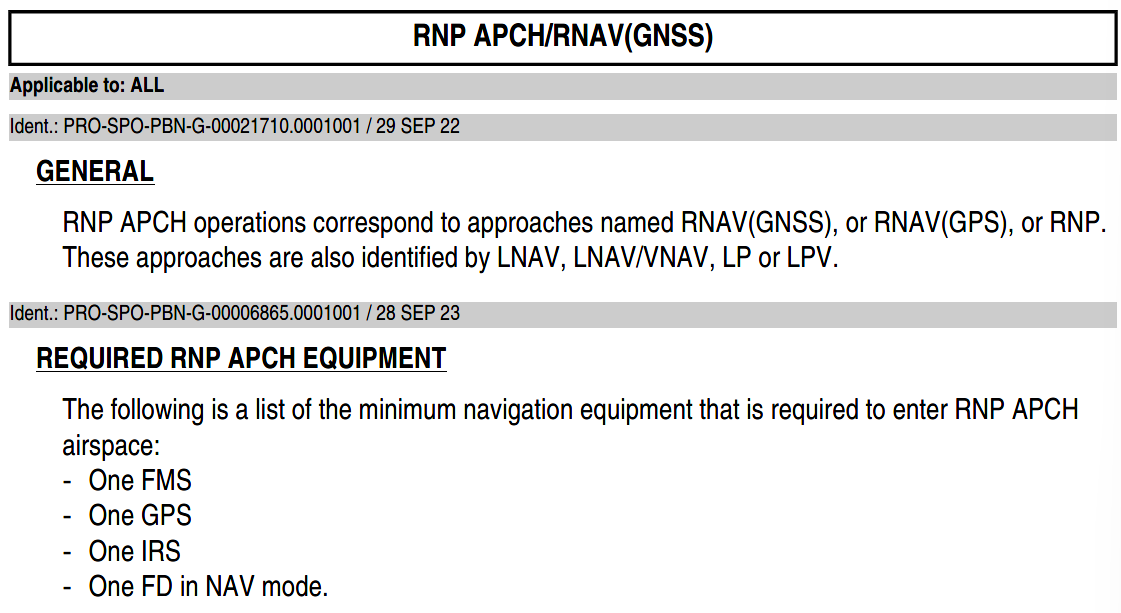
然而,如果使用 NAV FPA 引导,在 FCOM PRO-NOR-SOP-180-C C APPROACH USING FPA GUIDANCE 中,没有让参考 REQUIRED RNP APCH EQUIPMENT,而是直接写了所需设备:只需要一部 NAV PRIMARY 模式下的 FMS,没有提到 FD。
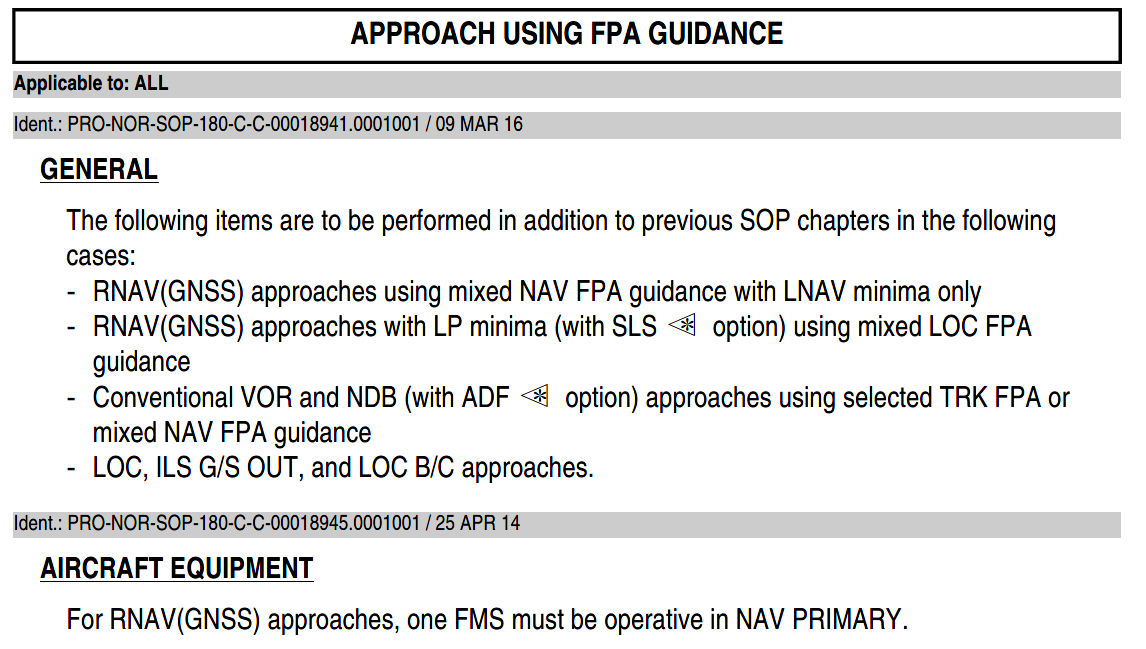
那么为什么 LNAV minima 的 RNAV(GNSS) 进近,这两种不同的引导模式,对 FD 的需求不一样呢?
来来回回问了4次,空客的回复比较混乱,甚至有点扯闲篇。总之,最后终于在“重新考虑”之后,认为都应该统一到 PRO-SPO PBN RNP APCH 部分的设备要求。也就是需要 FD。
手册在后续可能会修改,作为保守方案,空客认为公司可以先按照 PRO-SPO PBN RNP APCH 部分的设备要求来执行。
TR-81510379 原文
Q1
Refer to FCOM PRO-NOR-SOP-180-C C APPROACH USING FPA GUIDANCE – AIRCRAFT EQUIPMENT, “For RNAV(GNSS) approaches, one FMS must be operative in NAV PRIMARY”, without mention of FD.
![[Is the FD required for an RNAV (GNSS) approach with LNAV minima using NAV FPA guidance_image_3.png|600]]
However, in FCOM PRO-SPO-PBN J RNP APCH/RNAV(GNSS) – REQUIRED RNP APCH EQUIPMENT, “One FD in NAV mode” is required.
![[Is the FD required for an RNAV (GNSS) approach with LNAV minima using NAV FPA guidance_image_2.png|600]]
So, which is correct?
A1
We confirm both information are correct.
As stated in FCOM PRO-SPO-PBN – RNP APCH/RNAV(GNSS), One FD in NAV mode is required to enter RNP APCH/RNAV(GNSS) airspace.
The FD is required in initial, intermediate, and missed approach segments in order to comply with the RNP requirement.
However, in most cases, FD is not required in RNP APCH/RNAV(GNSS) final segment.
Q2
Is the reason for not requiring FD in the final approach segment because it is always a straight segment?
Additionally, should the FCOM (PRO-NOR-SOP-180-C C APPROACH USING FPA GUIDANCE – AIRCRAFT EQUIPMENT.) clearly specify that only NAV PRIMARY is required in the final approach segment, while FD is still needed in other approach segments?”
A2
As stated in the previous answer, the FD is required for RNAV(GNSS) approach done in FPA/NAV with LNAV minima.
This is why it is stated “One FD in NAV Mode” in FCOM PRO-SPO-PBN J RNP APCH/RNAV(GNSS) – REQUIRED RNP APCH EQUIPMENT.
As per PRO-NOR-SOP-180-APPROACH USING FPA GUIDANCE, AT MINIMUM:
“MINIMUM………………………………………………………………….MONITOR or ANNOUNCE
Below minimum, the visual reference must be the primary reference until landing.
- If visual references are sufficient: CONTINUE…………………………………………………………………………….. ANNOUNCE
AP………………………………………………………………………………………………………OFF
FD………………………………………………………………………………………………………OFF
The PF orders the PM to set both FD off.”
As you can see, even if not listed in the aircraft equipment, current FCOM SOP for APPROACH USING FPA GUIDANCE procedure cover usage of FD during final approach until minimum.
Q3
Your answer make me confused.
Firstly, in A2, you mentioned “As stated in the previous answer, the FD is required for RNAV(GNSS) approach done in FPA/NAV with LNAV minima.” But actully, there’s not such description in A1. And in FCOM PRO-NOR-SOP-180-APPROACH USING FPA GUIDANCE, “ one FMS must be operative in NAV PRIMARY”,not about FD。
Secondly, in A2, PRO-NOR-SOP-180-APPROACH USING FPA GUIDANCE, AT MINIMUM require ” If visual references are sufficient: FD off”. That means before FD OFF, FD is ON. However in PRO-NOR-SOP-180-APPROACH USING FPA GUIDANCE – AIRCRAFT EQUIPMENT , there’s no need of FD, only “one FMS must be operative in NAV PRIMARY”.
So my question hasn’t been answered clearly.
Let’s go through this problem again.
In FCOM PRO-SPO-PBN – RNP APCH/RNAV(GNSS), one FD in NAV mode is required to enter RNP APCH/RNAV(GNSS) airspace.
In the AIRCRAFT EQUIPMENT of PRO-NOR-SOP-180-C APPROACH USING XLS GUIDANCE, it also refers to PRO-SPO-PBN – RNP APCH, that is, one FD is also required.
However, in the AIRCRAFT EQUIPMENT of PRO-NOR-SOP-180-APPROACH USING FPA GUIDANCE, it only mentions that one FMS must be operative in NAV PRIMARY.
My question is that the requirements for FD in RNAV(GNSS) approaches using XLS and FPA guidance are different. What is the reason for this?
If what is mentioned in A1, “However, in most cases, FD is not required in RNP APCH/RNAV(GNSS) final segment.”, is correct, could you please tell me the specific reason why the requirement for FD in the final segment is different from that in other flight segments? In addition, whether it is guided by XLS or FPA, there is a final segment. Then why are the requirements for FD different in RNAV(GNSS) approaches using XLS and FPA guidance?
A3
Please keep in mind the FCOM PRO NOR SOP are procedure recommended by Airbus.
As such, Airbus indeed recommend the use of FD for the whole approach procedure.
This is in line with Airbus golden rules #2 : Use the appropriate level of automation at all times.
As stated in message 81510379/003, in most cases, FD is not required in RNP APCH/RNAV(GNSS) final segment.
It is then up to CSC to adapt the SOP in order to match with the airline policy on this subject (i.e. to not use FD during final segment).
Q4
My concern focuses on the inconsistency in FD requirements between the two guidance modes for the same approach type.
The previous response was not clear enough, and what is contradictory is that if, according to the statement in the second reply, “As you can see, even if not listed in the aircraft equipment, current FCOM SOP for APPROACH USING FPA GUIDANCE procedure covers usage of FD during final approach until minimum,” then FD should be explicitly included in the required equipment.
Therefore, I am now rephrasing my question and hope to receive an accurate response.
In FCOM PRO-NOR-SOP-180-C A APPROACH USING XLS GUIDANCE, under AIRCRAFT EQUIPMENT For RNAV(GNSS) approaches, it is required to refer to PRO-SPO-PBN Required RNP APCH Equipment. And in REQUIRED RNP APCH EQUIPMENT, it is stated that “One FD in NAV mode is required to enter RNP APCH/RNAV(GNSS) airspace.”
In FCOM PRO-NOR-SOP-180-C C APPROACH USING FPA GUIDANCE, under AIRCRAFT EQUIPMENT, it only requires that For RNAV(GNSS) approaches, one FMS must be operative in NAV PRIMARY.
If for RNAV(GNSS) approach with LNAV minima, both XLS or NAV FPA can be used for guidance. Then why do these two different guidance modes have different requirements for FD for the same approach type?
A4
After reconsidering the information in this part of SOP, we agree this information could be reviewed to be harmonized with the required equipment information in the PRO-SPO PBN RNP APCH section.
We have launch the action to review it in next scheduled opportunity of FCOM revision.
As a conservative approach, CSC can refer to the required RNP APCH equipment list in FCOM PRO-SPO PBN to start RNP APCH operations.

Если вы ищете надежный автосервис для вашей Тойота в Москве, вам повезло. Профессионалы помогут вам с ремонтом и техническим обслуживанием.
Если вам нужен качественный и надежный автосервис Тойота в Москве, мы предлагаем широкий спектр услуг для вашего автомобиля.
Для Тойота необходим высокий уровень квалификации. Каждый механик проходит специальное обучение и сертификацию.
В автосервисе установлено современное оборудование. Это позволяет проводить диагностику и ремонт на высшем уровне.
Наш автосервис обеспечивает надежность и долговечность вашего автомобиля. Ваше доверие для нас — наивысшая награда.