
感谢同事的问题。
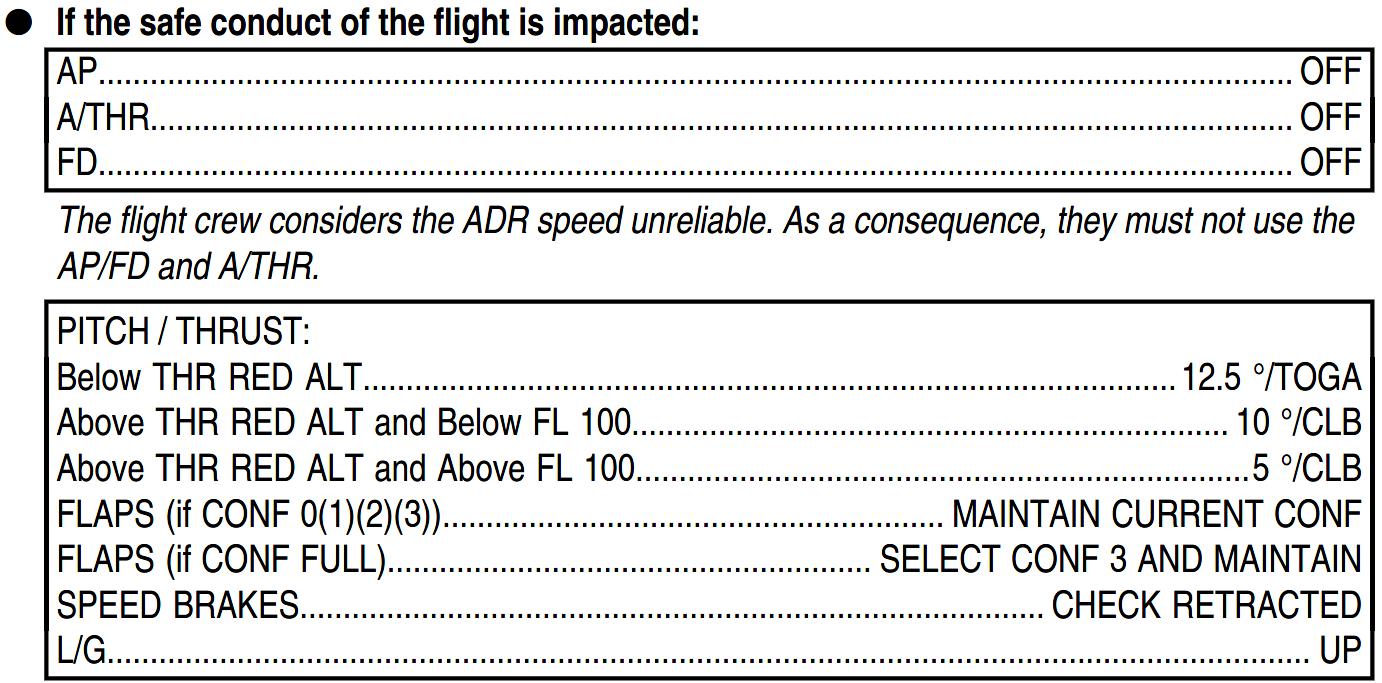
不可靠空速记忆项目的程序中,如果构型是 0-3 则保持,如果是全就要收到 3。为什么不能保持构型全呢?
空客的解释是,最初在 A320/A330 系列飞机上,不可靠空速程序是为起飞、爬升和巡航阶段设计的。不可靠空速情况主要由结冰条件导致,在爬升过程中或更常见于高空平飞时探头被堵塞所引起。在这些情况下,设计理念是保持飞机当前机翼构型不变,并根据俯仰/推力表设置相应的俯仰与推力组合值。
然而,有运营商报告了一次在最后进近阶段(约 800 英尺无线电高度)发生的不可靠空速事件,当时飞机处于 FULL 构型。在这种情况下,机组无法使用俯仰/推力表,因为该表未提供 3 以上构型的数值对。为解决这一问题,空客决定更新“不可靠空速指示/ADR 检查程序”的记忆项目,修改如下:当构型为 0、1、2、3 时,应保持当前构型;当构型为 FULL 时,应选择并保持构型 3。因此,当在 FULL 构型下发生不可靠空速情况时,机组必须收回一档,以便能够使用俯仰/推力表。
至于为什么应对措施是将构型 FULL 收到 3,而不是增加构型 FULL 对应的俯仰/推力呢?空客解释由于构型全阻力太大,在不可靠空速情况下,性能不足以按照俯仰/推力来保持飞机状态。
另外,空客还提到,对于 A350,在不可靠空速情况下,PRIM 会自动执行大气数据源重构功能。在这种情况下完全没有备用空速源的可能性被认为极低。因此在 A350 上,通常会使用备用空速而不是依赖俯仰-N1 表。尽管 A350 具有这种特定设计,空客仍决定保留与 A330 相同的记忆程序,以便于通用型别等级训练,并保持机队之间的共通性。
我对这解释的延申理解是,如果不考虑多机型统一程序,单从技术上来讲,A350 完全可以在不可靠空速的时候直接转换 AIR DATA 旋钮,飞 BKUP SOURCE。其实就算飞记忆项目,飞机稳定后调出[ABN]程序,就是要求转换 AIR DATA,一样的。
TR-81719682 原文
Q1
What is the reason of “FLAPS (if CONF FULL)…. SELECT CONF 3 AND MAINTAIN” in [MEM] UNRELIABLE AIR SPEED INDICATION, instead of maintain CONF FULL?
A1
Please be informed that initially, in A320/A330 family aircrafts, the Unreliable Airspeed procedure was designed for Takeoff, Climb and Cruise phases. The Unreliable Airspeeds situations are mainly due to icing conditions that cause probes obstructions during climb or mainly during level flight at high altitude. In these situations, the Airbus philosophy is to keep the aircraft in the current wing shape configuration and set the applicable pitch/thrust value pair as per pitch/thrust table.
However, an operator reported an Unreliable Airspeed event during final approach (800ft RA) with the aircraft configuration set at FULL. In this case, the flight crew was unable to use the pitch/thrust table since no value pairs are given for configuration above 3. To address this situation, Airbus decided to update the UNRELIABLE SPEED INDICATION/ADR CHECK PROC memory items as follows:
- When the configuration is 0, 1, 2, 3, the configuration must be maintained.
- When the configuration is at full, the configuration 3 must be selected and maintained. Therefore, when an Unreliable Airspeed situation occurs and the aircraft configuration is at FULL, the flight crew must retract one step to be able to use the pitch/thrust table.
However, in A350, during the unreliable airspeed situation, there is an automatic reconfiguration function of the air source done by PRIM. It is considered very unlikely to not have a backup source in this case. So normally, in A350, we will use backup airspeed in case of unreliable airspeed than using the pitch/thrust table (i.e. Pitch-N1 table). Despite the specific design of the A350, we decided to keep a memory procedure common with the A330 for common type rating training and maintain the commonality between fleets.
Q2
Thank you for Airbus’s detailed explanation.
I am curious as to why, following an unreliable airspeed event at 800ft RA, the procedure calls for retracting the configuration from FULL to CONF 3, rather than adding the pitch/thrust data corresponding to CONFIG FULL.
Is this procedure more convenient, or are there limitations in CONFIG FULL that prevent providing pitch/thrust data?
A2
Please be informed that when the aircraft is in CONF FULL, the associated drag is important. However, during the unreliable airspeed indication, the aircraft might not have sufficient performance to maintain the aircraft with the requesting pitch/thrust. Therefore, if the aircraft is in CONF FULL, the procedure request to select flap to CONF 3 and maintain.
